

Pneumonia Testing Market to reach USD 4.63 Billion by 2035 at 7.40% CAGR
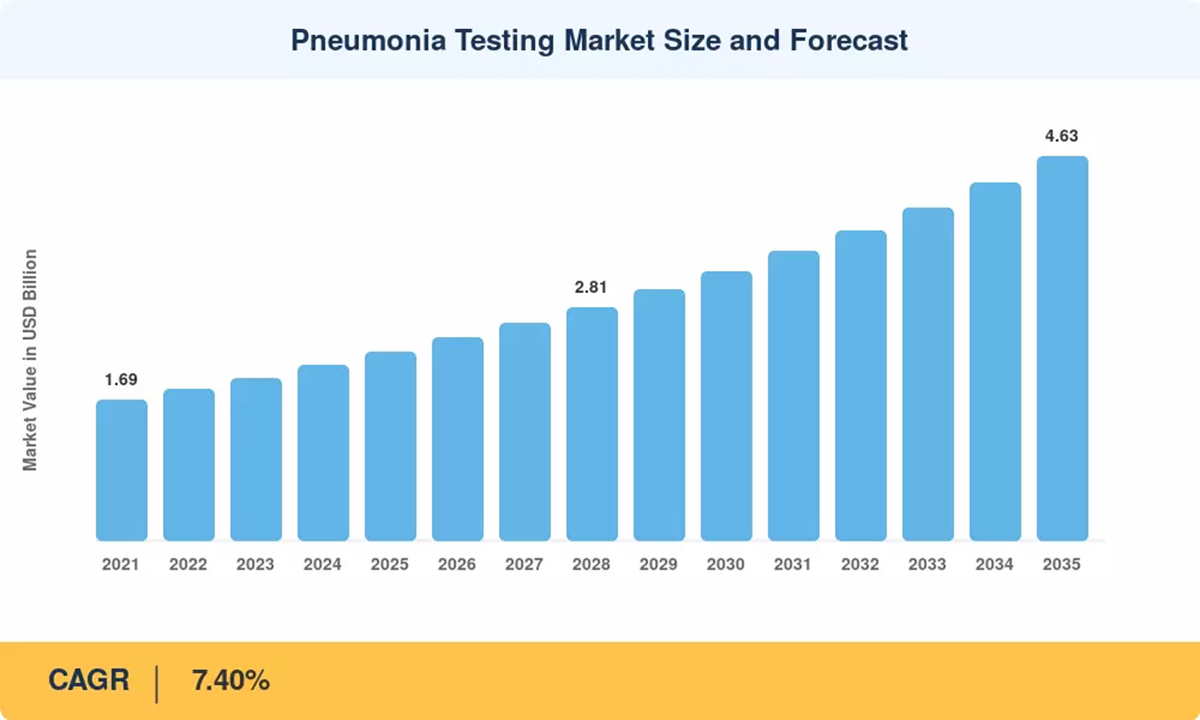
Pneumonia Testing Market Size
Pneumonia Testing Market to Surge from $2.44B in 2026 to $4.63B by 2035-By Rising Pneumonia Incidence and Antimicrobial Resistance, Multiplex Molecular Panel
NY, CA, UNITED STATES, July 14, 2026 /EINPresswire.com/ -- As per Market Research Future, the global Pneumonia Testing Market size to reach USD 4.63 Billion by 2035 from USD 2.44 Billion in 2026, at a CAGR of 7.40% during the forecast period 2026--2035. The market base was estimated at USD 2.27 Billion in 2025.The 7.40% CAGR---anchored by structural infectious disease diagnostic demand rather than discretionary healthcare spending---is driven by three converging forces: the WHO's estimate that pneumonia kills over 2.5 million people annually, including 700,000 children under five, with antimicrobial-resistant Streptococcus pneumoniae strains now exceeding 30% prevalence in multiple WHO regions.
The escalating adoption of rapid point-of-care diagnostics across primary care networks, with the U.S. CMS granting new CPT reimbursement codes for several FDA-cleared syndromic respiratory panels in 2024 and emergency departments now accounting for over 40% of POC respiratory test utilization in the United States; and the decisive shift from conventional culture-based methods toward molecular and antigen-based platforms that deliver results within 15--45 minutes rather than 24--72 hours. The Pneumonia Testing Market is no longer a centralized laboratory workflow---it sits at the intersection of antimicrobial stewardship, bedside triage, and syndromic surveillance.
National governments and multilateral health organizations are amplifying this momentum. The U.S. CDC's Advanced Molecular Detection initiative has directed over USD 170 million since its inception toward next-generation respiratory surveillance infrastructure, accelerating the integration of multiplex PCR and isothermal amplification panels into hospital emergency departments and urgent care clinics.
Gavi, the Vaccine Alliance, has committed over USD 1.5 billion to pneumococcal vaccine introduction in 60+ low-income countries, and parallel investments in diagnostic infrastructure are creating testing capacity where none previously existed. The WHO's Global Action Plan on AMR has catalyzed national action plans in over 140 countries, many of which mandate diagnostic testing prior to antibiotic prescription in hospital settings. Together, these initiatives are creating the procurement infrastructure and surveillance frameworks on which the Pneumonia Testing Market depends.
Request A Free Sample: https://www.marketresearchfuture.com/sample_request/21472
Key Market Trends & Growth Drivers
Rising Pneumonia Incidence and Antimicrobial Resistance
Pneumonia remains the single largest infectious cause of death in children globally, and antimicrobial-resistant Streptococcus pneumoniae strains now exceed 30% prevalence in multiple WHO regions. This resistance crisis compels clinicians to identify causative pathogens before prescribing antibiotics, directly expanding the addressable volume for rapid diagnostic tests.
The WHO's Global Action Plan on AMR has catalyzed national action plans in over 140 countries, many of which mandate diagnostic testing prior to antibiotic prescription in hospital settings---a policy shift that directly benefits the Pneumonia Testing Market. Each percentage point of AMR prevalence gain translates into measurable procurement volume, and the stewardship paradigm embedded in hospital infection control makes this driver structurally durable through 2035.
POC Testing Adoption and Decentralization
Rapid point-of-care platforms have transformed pneumonia diagnosis by delivering actionable results within 15--30 minutes at the bedside, eliminating the delays inherent in centralized laboratory workflows. The U.S. CMS granted new CPT reimbursement codes for several FDA-cleared syndromic respiratory panels in 2024, expanding payer coverage and accelerating hospital adoption.
Emergency departments now account for over 40% of POC respiratory test utilization in the United States, and this model is being replicated across European urgent care networks. In areas where centralized laboratory capacity and turnaround time constraints limit clinical throughput, investment in decentralized molecular platforms is accelerating adoption. The overall program economics are improved by a decreased length-of-stay and reduced unnecessary antibiotic prescribing.
Multiplex Molecular Panel Innovation
Syndromic respiratory panels that simultaneously detect 15--20+ pathogens (including bacterial, viral, and atypical organisms) from a single nasopharyngeal swab have become the clinical standard in tertiary care settings. The BioFire FilmArray and Cepheid Xpert platforms collectively process millions of respiratory panels annually, and next-generation versions targeting lower cost-per-test are expanding addressable markets into community hospitals and outpatient clinics.
Manufacturers are investing heavily in panel miniaturization and room-temperature reagent storage to enable deployment in tropical and resource-limited environments. As syndromic panel consolidation accelerates, manufacturers able to supply broad-menu, rapid-turnaround platforms capture a disproportionate share.
Ask for Customization: https://www.marketresearchfuture.com/ask_for_customize/21472
Market Segment Insights
BY PRODUCT TYPE
Consumables: Dominant segment with ~63% revenue share in 2025. Reflecting recurring spend on reagent kits, cartridges, and assay panels. Every manufacturing run---whether for molecular syndromic panels or immunodiagnostic rapid tests---consumes reagents, test cartridges, and calibration materials. This repeat-purchase dynamic insulates the segment from cyclical investment fluctuations and provides predictable revenue streams for suppliers. BioMérieux and Abbott anchor this segment.
Analyzers: Fastest-growing product class at 8.2% CAGR (2026--2035). Fueled by hospitals investing in next-generation multiplex platforms. Next-generation analyzers featuring random-access capability, reduced footprints, and connectivity to laboratory information systems are displacing legacy platforms and driving upgrade cycles even in mature markets. As emerging-market hospital infrastructure expands, manufacturers able to supply compact, user-friendly platforms capture a disproportionate share.
BY TECHNOLOGY
Polymerase Chain Reaction (PCR): Dominant technology with ~38% of the Pneumonia Testing Market in 2025. The clinical standard for pathogen identification, PCR-based syndromic panels detect bacterial, viral, and atypical pathogens from a single sample with high sensitivity and specificity. The BioFire FilmArray Pneumonia Panel and Cepheid Xpert Xpress platforms have established clinical adoption benchmarks.
Enzyme-Linked Immunosorbent Assay (ELISA): USD 0.41 Billion in 2025; serological antibody detection and antigen quantification support epidemiological surveillance and vaccine efficacy studies.
BY METHOD TYPE
Molecular Diagnostics: Dominant method type with ~38% of 2025 revenue, representing roughly USD 0.86 Billion. Driven by PCR and isothermal amplification adoption. Syndromic respiratory panels that detect 15--20+ pathogens from a single nasopharyngeal swab have become the clinical standard in tertiary care settings, creating locked-in consumable demand.
Immunodiagnostics: USD 0.49 Billion in 2025; rapid antigen detection in emergency settings maintains strong utilization where speed and simplicity outweigh the broader pathogen coverage of molecular approaches.
Point-of-Care (POC) Testing: Fastest-growing method type. Rapid point-of-care platforms deliver actionable results within 15--30 minutes at the bedside, eliminating delays inherent in centralized laboratory workflows. The U.S. CMS granted new CPT reimbursement codes for several FDA-cleared syndromic respiratory panels in 2024, expanding payer coverage and accelerating hospital adoption.
BY END USER
Hospitals: Largest segment at ~52% share in 2025, representing roughly USD 1.18 Billion. Emergency departments, intensive care units, and pediatric wards generate the highest testing volumes. The trend toward syndromic panel adoption at the point of care within hospital networks is shifting testing from centralized laboratories to bedside analyzers. National hospital procurement through ministries of health and group purchasing organizations dominates volume.
Diagnostic Centers: USD 0.61 Billion in 2025; reference testing and batch processing for lower-acuity samples and confirmatory pathogen identification.
Read Detailed Insights: https://www.marketresearchfuture.com/reports/pneumonia-testing-market-21472
Regional Outlook
North America --- Dominant Market (~38.5% Share, 2025)
The United States generates approximately 78% of North American Pneumonia Testing Market revenue, driven by high test utilization rates and robust reimbursement frameworks. The FDA's De Novo and 510(k) clearance pathways have enabled over a dozen respiratory syndromic panels to reach market since 2020, and hospital systems like HCA Healthcare and Ascension have standardized molecular respiratory testing protocols across their facilities. CMS granted new CPT reimbursement codes for several FDA-cleared syndromic respiratory panels in 2024, expanding payer coverage and accelerating hospital adoption. Reimbursement breadth and high per-capita diagnostic spending support premium-priced multiplex panel demand that emerging markets cannot match.
Canada contributes through provincial lab modernization initiatives at a 7.0% CAGR, while Mexico is growing at a solid pace on IMSS procurement program expansion, contributing USD 0.04 Billion in 2025. North America's leadership rests on payer infrastructure depth and the structural syndromic-panel segment created by expanded antimicrobial stewardship mandates and emergency department triage protocols.
Europe --- Second Largest (~27% Share, 2025)
Europe's Pneumonia Testing Market reflects divergent national strategies---Germany leads regionally with reference laboratory network strength, representing 22% of regional share, while the UK historically used selective hospital targeting before broadening coverage through NHS antimicrobial stewardship mandates and NICE guidance recommending point-of-care CRP and procalcitonin testing to guide antibiotic decisions in suspected lower respiratory tract infections.
France contributes USD 0.09 Billion through its national pneumonia surveillance program. Italy contributes 11% of regional share on hospital-acquired pneumonia monitoring. Harmonization pressure from the EU In Vitro Diagnostic Regulation (IVDR 2017/746), which took full effect in 2022, is gradually narrowing these differences, lifting baseline demand across the region as standardized quality frameworks reduce duplicate testing. The Nordic countries are growing at a steady pace on high per-capita healthcare spending. Spain contributes through primary care POC testing expansion at 6.9% CAGR. Russia holds 7% of regional share through federal tuberculosis/pneumonia co-testing programs.
Asia-Pacific --- Fastest-Growing Region (9.1% CAGR, 2026--2035)
Asia-Pacific is the engine of the Pneumonia Testing Market. China holds the largest regional share with 35% of regional revenue, its Healthy China 2030 blueprint allocating significant resources to county-level hospital laboratory capacity, with tier-2 and tier-3 hospital upgrades driving first-time molecular platform installations. India is growing at 10.2% CAGR---the fastest-growing country in the region---on the back of Ayushman Bharat and ICMR diagnostic expansion, with the ICMR network of viral research and diagnostic laboratories expanding to over 80 sites equipped with molecular respiratory testing capabilities.
ASEAN economies show strong growth at 9.5% CAGR as WHO Essential Diagnostics List adoption converges with hospital infrastructure build-out. Japan contributes USD 0.08 Billion through its aging population and high pneumonia mortality in elderly cohorts. South Korea contributes 12% of regional share on National Health Insurance rapid test coverage. The rest of Asia-Pacific is growing on bilateral health aid programs. The region's combined contribution anchors the global volume base for multiplex molecular and POC diagnostic demand.
Middle East & Africa --- Emerging Opportunity (8.4% CAGR, 2026--2035)
The Middle East & Africa carries the widest diagnostic infrastructure gap and therefore the steepest long-term opportunity. Saudi Arabia leads the region with Vision 2030 healthcare modernization, contributing 28% of regional share. Premium private hospital investment in Riyadh and Jeddah drives demand for high-throughput molecular platforms. The UAE is growing at 8.0% CAGR through premium private hospital investment across Dubai and Abu Dhabi.
South Africa is growing at a solid pace on NHLS reference laboratory network expansion, contributing USD 0.02 Billion. Egypt is growing at 8.8% CAGR through universal health insurance rollout. The rest of the region is growing steadily on UNICEF/WHO pediatric pneumonia programs. UNICEF's Pneumonia Diagnostics Project has distributed over 3 million rapid breathing timers and pulse oximeters across 15 African countries, and companion diagnostic test procurement is scaling alongside these programs. Greenfield construction gives OEMs an opportunity to specify integrated diagnostic ecosystems from the ground up.
Competitive Landscape and Recent Developments
The Pneumonia Testing Market exhibits moderate concentration, with an estimated Herfindahl-Hirschman Index in the 1,200--1,400 range and the top five players collectively holding an estimated 45--50% of global revenue. The competitive field spans large diversified diagnostics conglomerates and specialized molecular diagnostics firms. Competition centers on menu breadth, turnaround time, installed base expansion, and the ability to secure bundled consumable supply contracts with hospital group purchasing organizations.
The competitive landscape is stratified between syndromic panel leaders serving hospital and reference laboratory markets, rapid antigen specialists capturing emergency department and POC demand, and integrated imaging-plus-testing platforms consolidating the AI-augmented diagnostic segment.
KEY COMPANIES AND RECENT MILESTONES
BioMérieux (2024--2025): Maintains leadership with the BioFire FilmArray Pneumonia Panel and VITEK blood culture systems, commanding ~10--13% of global Pneumonia Testing Market revenue. Syndromic panel market leader with a strong hospital install base.
Abbott Laboratories (2024--2025): ID NOW and Alinity m respiratory assays anchor a broad POC-to-central lab portfolio with global distribution, holding ~8--11% of global revenue.
Becton Dickinson (2024--2025): BD Veritor and BD MAX respiratory panels anchor an integrated sample-to-result molecular platform strategy, holding ~7--10% of global revenue.
Cepheid (Danaher) (2024--2025): Xpert Xpress Flu/RSV and GeneXpert system anchor a dominant POC molecular brand with LMIC distribution strength, holding ~6--9% of global revenue.
Roche Diagnostics (November 2023): Introduced the cobas eplex Respiratory Panel 2.0, featuring a 90-minute sample-to-result workflow with 22 pathogen targets and three resistance markers. High-throughput centralized testing and automation leadership support ~5--8% of global revenue.
Future Outlook: 2026--2035
By 2030, AI-integrated diagnostic ecosystems will become the operating system of pneumonia diagnosis. Machine learning algorithms based on chest X-ray datasets, electronic health record variables, and laboratory biomarkers are being integrated into pneumonia diagnostic workflows to increase triage accuracy and prevent unnecessary antibiotic prescriptions. Qure.ai's FDA-cleared chest X-ray AI product and similar platforms are being bundled with laboratory diagnostics, producing integrated imaging-plus-testing solutions that command premium pricing and improve clinical outcomes. The WHO estimates that AI-assisted diagnostics could reduce inappropriate antibiotic prescriptions by 25--30% in hospital settings by 2032. By 2030, leading platforms are expected to offer real-time clinical decision support that synthesizes laboratory results, chest imaging, patient history, and local epidemiological data to generate pathogen probability scores and antibiotic recommendations.
Microfluidics and lab-on-chip miniaturization will reframe cost structures by the early 2030s. Advances in microfluidic engineering are driving the development of ultra-compact, battery-operated diagnostic cartridges capable of performing sample-to-answer molecular testing without laboratory infrastructure. Companies including Cepheid, Abbott, and Molbio Diagnostics are investing in platforms that weigh under 2 kilograms and operate at ambient temperatures, targeting community health worker programs in rural South Asia and Sub-Saharan Africa. The Pneumonia Testing Market stands to benefit substantially as these platforms achieve unit economics below USD 10 per test by the early 2030s. As per-test costs fall with scale, the addressable channel widens from tertiary hospitals to community health centers and pharmacy-based testing sites, extending molecular diagnostics beyond traditional settings.
More Related Research Insights:
https://www.marketresearchfuture.com/reports/androgen-replacement-therapy-market-26914
https://www.marketresearchfuture.com/reports/spot-vision-screener-market-41213
https://www.marketresearchfuture.com/reports/ankle-mobile-bearing-system-market-38418
https://www.marketresearchfuture.com/reports/sex-toys-market-67800
https://www.marketresearchfuture.com/reports/blood-preparation-market-42263
https://www.marketresearchfuture.com/reports/congenital-hyperinsulinism-market-40723
https://www.marketresearchfuture.com/reports/surgical-tourniquet-market-42397
https://www.marketresearchfuture.com/reports/point-of-care-sepsis-diagnostics-market-43633
https://www.marketresearchfuture.com/reports/smart-antimicrobial-healthcare-coatings-surfaces-market-38898
https://www.marketresearchfuture.com/reports/tinea-pedis-treatment-market-42594
Larry Wilson
WantStats Research And Media Pvt. Ltd.
+1 855-661-4441
email us here
Visit us on social media:
LinkedIn
Facebook
YouTube
X
Legal Disclaimer:
EIN Presswire provides this news content "as is" without warranty of any kind. We do not accept any responsibility or liability for the accuracy, content, images, videos, licenses, completeness, legality, or reliability of the information contained in this article. If you have any complaints or copyright issues related to this article, kindly contact the author above.
